
Written March, 2020
When we got off the plane at Danang Air Base we were slapped with an intense wave of heat and humidity that furthered the intensity of our drunken hangovers.
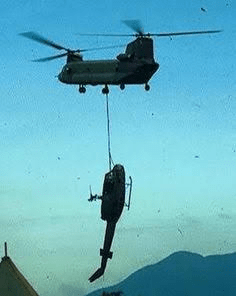
It was late April or early May. I can’t remember and don’t have records of the exact date. We gathered our seabags and starting walking across the landing field toward some buildings. We heard a commotion and looked up and saw a big Chinook helicopter carrying a burned and mangled Huey Helicopter onto the base.
We all wondered how many marines were killed or wounded in that event.
Once again the mantra, “what the hell were we thinking?”
We walked to the Marine Dispatch Center for our assignments, wondering and worrying what was next for us. The biggest question for George and I was, “will they keep us together?” We did not want to be separated.
We sat in a small auditorium and waited for our names to be called for our assignment.
Trucks would pull up outside, names would be called, and a batch of marines would hop on the open air trucks and head off to who knows where. It seemed like we were going to be the last ones called after hours of waiting. Eventually George was called in a group but not me. We said a quick goodbye and we never had any further contact while we were both in Vietnam. I asked the dispatch officer about my status and he told me that my assignment was dubious because some units needed riflemen and some units needed someone trained on the 105 mm weapon. They were fighting over me? Apparently they didn’t know how incompetent I was.
Finally, my name was called. The last few remaining marines and I boarded a truck. We drove through part of the base and then through some poor neighborhoods of Danang. We were on the truck with some marines who obviously had been in country for a while. We received the customary name calling and general disrespect.
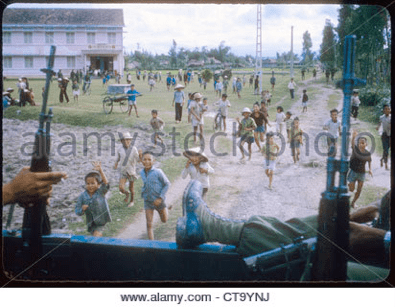
We were chased by the local children begging for “chop chop”, (food). The experienced marines were tossing cans of rations into the ditch to watch the kids fight over the food. Two of them were throwing cans like fastballs aimed at the little kids. They were laughing like it was sport. I asked them why they were doing that. In so many words, they said it was “sport“ messing with the “gook” kids. They clearly had no regard for the Vietnamese people, but kids? That’s when I first realized that something was very wrong with the whole situation. I thought we were supposed to be the good guys.
We drove back into another part of the base to the transient housing area and began orienting to our living area. We were told that we would have a day job plus overnight perimeter guard duty on a regular basis until we were permanently assigned to a combat unit.
Danang Air Base was heavily attacked during the massive Tet offensive in January and February. There was still a lot of damage apparent on the base. There had been a lot of casualties and reinforcements were pouring in from the US. Things seemed disorganized, bordering on chaos. We heard that a lot of the experienced leaders had been killed or wounded or went home at the end of their tours. Anyone with half a brain and some common sense was moving up the chain of command and sent out to lead combat units. The old lifers who couldn’t hack it in the bush were left behind to make our lives miserable.
The marines that were in our housing units were either new like me or wounded marines who were returning to duty, (most of whom wished that their wounds had been worse).
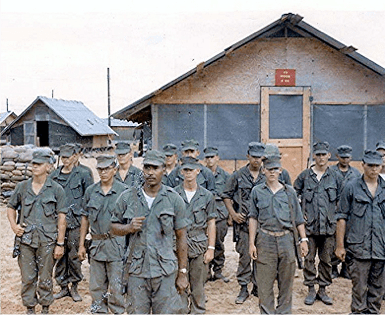
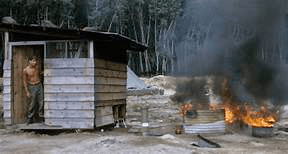
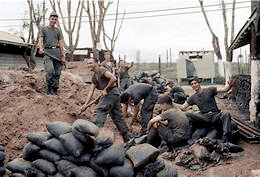
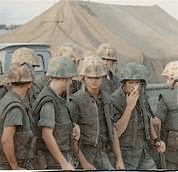
Every other man in the fighting trench gets to sleep 2 or 3 hours at a time. If you fall asleep on your watch you are in serious trouble. Many casualties were attributed to troops sleeping on watch.
We had a safety bunker near our living quarters. There were regular but inconsistent rocket attacks on different parts of the base. I only had to get to the bunker once in the time I was there. I learned what fear smells like.
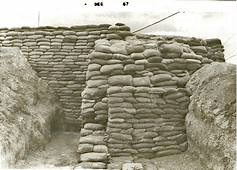
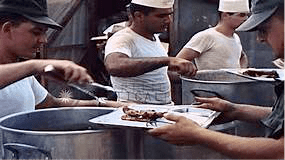
I believe that I did one or two nights of perimeter defense and then graduated to large scale night patrols at the Marble Mountains. I also graduated to work in the mess hall on a regular basis, which was definitely a promotion from flaming poop and filling sandbags.
The Marble Mountains were a small group of mountains in the middle of the city of Danang. The mountains had many caves of all sizes and were heavily vegetated on the outside. Enemy forces would hide in there during the day and come out at night and attack Americans or move through the city to collect supplies.
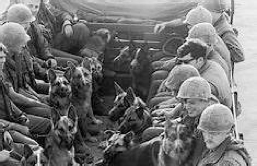
We were set up in “blocking” positions to catch Viet Cong or NVA coming out. Sometimes a group of marines with dogs would go in to flush them all out of the caves at once. I was involved in this a couple of times. Nothing ever happened. Never fired a shot.

It didn’t seem like I was ever going to be assigned to a combat battalion. Every time a leader came and told me/us what we were doing that day it was like they weren’t sure who we were. We were just day (and night) laborer’s passing through to nowhere. I heard that most of the clerks had been pulled off their desks and sent into combat. They were the ones who kept track of everyone, thus the chaos. I hated filling sandbags and burning shit. Being in the mess hall during the day and living in a fighting hole every other night seemed pretty cushy. I even got to see a couple of movies. All of this is clumped together in my memory. The amount of time spent here is hard to tell. Maybe this was 10 days in Danang.
Soon enough they called about a dozen of us out of our hut at night and told us to pack our gear.
Phu Bai Combat Base
The next morning we took a small airplane to the Phu Bai Combat Base.
The facilities there were much more primitive than Danang Base. Us new guys were sprinkled into huts, (“hootches”), with combat veterans. They told us about the savage house to
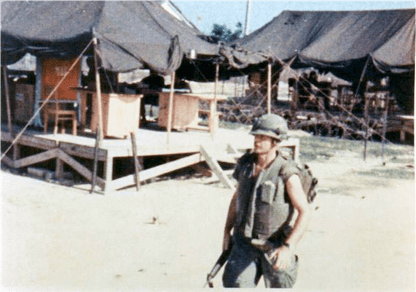

house fighting in the nearby city of Hue. You couldn’t tell who were civilians and who were the enemy. There were a lot of casualties and snipers everywhere.

Battle of Hue
These marines hated the Vietnamese. It was somewhat understandable since they all had friends who were killed or horribly wounded. Some of them claimed to be sympathetic to the local people but that seemed to be reserved for the sex workers.
The heavy fighting in the rural areas forced a lot of young women to flee to the cities. Prostitution was often the only way to survive. But now, due to the lack of security after the Tet offensive, all bases in the northern sector were locked down. No more outings for the troops to go to the local bars, sex dispensaries, or opium dens. In addition to the infiltration of enemy soldiers into all areas of society, VC females were posing as prostitutes and deliberately infecting our troops, (according to local legend).
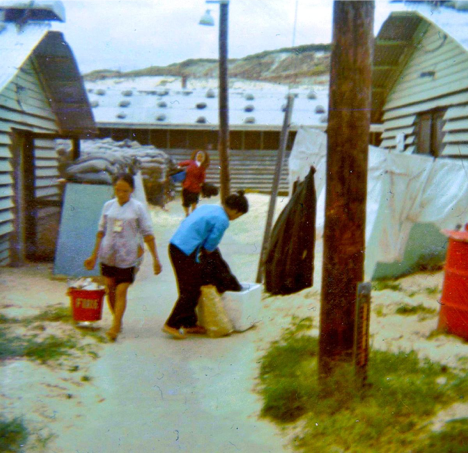
What a surprise that there was currently no master plan for us. We were put back on mess duty. Fortunately, I was assigned to the “pot shack” (not the love shack), where all the big cooking supplies were washed by Vietnamese men and women. It was my first contact with the people of Vietnam. Although this assignment only lasted a couple of days, I immediately became very fond of them. They were fun-loving and hard working.
They were searched on their way in and out. My orders were to not allow any of the civilian workers to take food out of the kitchen and off the base. We were told that they would give it to enemy troops. I knew that people in the area were suffering. The heavy
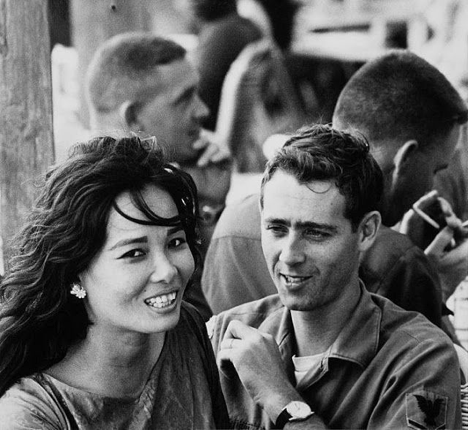
fighting of the Tet Offensive had driven many farmers off the land. I couldn’t bring myself to follow the order. When the local workers non verbally questioned me about scraping leftover food out of the big cooking pots and hiding it in their clothing, I just nodded and turned away. I planned on playing dumb if I was questioned by the MPs. My life with May Curran had made me an excellent liar.
Other civilians were allowed on the base to do menial work. Marines could pay “maids “ to do their laundry or clean our hootches. The marines treated the ladies as sex objects or lowly servants. There were a few decent men in our group, but not many. I think the group macho effect is very powerful.

We would occasionally get mail, often 10 letters from home in one chunk. I was able to correspond with my brother Mike who was right next door in Thailand. I would try to save the letters so there wouldn’t be a drought of mail. One letter per day, maybe two.
At first there were a lot of letters coming in from friends and family. Gradually it slowed down as the novelty of it all wore off.
Meanwhile, when I was not on guard duty or night patrol I used the Enlisted Men’s Club a couple of times. It was a tent serving almost cool beer. It was filled with angry, drunk, and

depressed marines. Tension between blacks and whites was very high so I decided to stay in my hootch at night. We were sleeping with our loaded M16s next to our cots. This was in case of race war or being overrun by NVA troops who were still heavily concentrated in the area. By choice the blacks and whites were living in separate quarters.
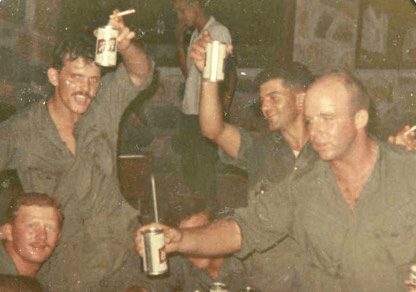
I guess I did an admirable job in the pot shack because I got transferred for a day to the Officer’s Mess at the CAG (Civilian Action Group) unit. These marines were specialized in living and working in rural villages to help the farmers defend themselves against the VC. I had heard about them and was kind of interested in signing up. I probably wasn’t qualified due to my lack of combat experience. I was waiting tables for the officers like the little bitch that I was.
The mess hall had a milk dispenser. The milk was in plastic bags inside cardboard boxes. I was trying to replace an empty container and the new box of milk was soaked and weakened at the edges. I tried to stuff it in to the dispenser and it burst open and soaked the commanding officer of CAG who was at the table right next to the milk machine. He was reasonably nice about it but I figured that was the end of my audition for the CAG Unit.
That was lunch. While preparing for the dinner shift some corporal came to me and said I had a phone call. I looked at him like he was crazy. He said, “private, get over there to the kitchen and get your phone call.” (By the way, he called me “private”, which is what I was. It is the lowest ranking marine. I had never met another private in Vietnam unless he had been demoted for some transgression. Every other marine who had completed training and set foot in Vietnam had been promoted to private first class, PFC. This lack of promotion made me feel like they didn’t have me on their radar at all. I guess my dad’s advice about staying quiet in the background was paying off.) Anyway, I figured that there was no phone call but that I was going to get a group ass kicking for spilling milk on the poor little colonel. I answered the phone and a crackly voice said “this is Sergeant crackle crackle,,,,. Who? Sergeant crackle crackle. Who?? It’s Mike, your brother. Holy shit, how did you find me?” He said he used the address from my letter to trace me. He had access to big time communication equipment at his Air Force base in Thailand.
We chatted for a minute and then I was interrupted by a squad leader who told me to get back to my hootch and get my gear together to go to the field first thing in the morning. I had to hang up with Mike and haul ass back to my area. That was a very cosmic high tech experience in those days.
This was going to be my first trip in a helicopter. And first trip to an active combat zone. Hopefully it was only a temporary gig because I was very valuable in the mess hall. I gathered all my gear and clothing. Fortunately, all that nighttime guard duty had taught me how to dress myself for combat. You had to get things in order. Layers were the fashion. Fatigue shirt, then flak jacket, then bandoliers for ammo. You must know the placement of the items on the cartridge belt; 5 or 6 canteens, knife, grenades, smoke grenades, C4, wound dressing, first aid kit, etc.
Then you had to fill your pack on the inside and out with everything else including: poncho and poncho liner, small folding shovel, rifle cleaning tools and oil, flashlight and batteries, empty sand bags, socks, 3-4 days of C ration cans, heat tabs to cook the food, camera, personal gear.
Finally, personal ammunition, cans of machine gun rounds, mortar rounds or other ammunition as assigned.

In the morning there was a quick breakfast and out to the landing zone to collect ammo and get team assignments.
We had a brief talk about where we were going and what we were doing. We were joining a “search and destroy” operation that was in progress.
We were going to be replacements for some marines that were killed or wounded.
We were going in on Hueys. We formed groups of 10-12 depending on whether there were 1 or 2 door gunners. At the LZ I was babbling, nervously asking a bunch of questions. A guy in my group that I knew said, “Curran, you ask too many questions”.

We loaded up and lifted off. It seemed like we were really going fast. I was watching the experienced marines to see if they looked scared. They did. They were sitting in the doorway so they could get off quickly in case we got fired on.
The plan was to jump off the Huey and start running to a tree line where our new comrades’ perimeter was set up. While in the air it was radioed to the pilot that our units on the ground were under sniper fire. “Hot LZ, haul ass”.

All I wanted to do was jump off the “bird” and keep up with my team and not fall down.
There were some short cracks of gunfire as we ran to the perimeter and then heavy fire from our perimeter in response.
We got to the perimeter within a large tree line without incident. A sergeant grabbed all of my team in a group and started telling us what was going on. He asked if any of us had not yet fired their weapon at all. A few of us had not. He said he would see us later for a weapons test.
We were told to wait there and someone would come and get us. As we waited I saw a wounded man sitting on the ground nearby with a corpsman. He had been shot by a sniper and was waiting for medevac. His boot was in tatters in the front and his ankle bones and muscles were showing. He must have had a morphine injection because he seemed pretty calm and comfortable. I tried not to keep looking at his wound but I couldn’t resist. He got wrapped up and taken to the next medevac chopper before I had a chance to barf.
Eventually I was grabbed by the sergeant and taken to the other side of the perimeter facing a farm field. He told me to lock and load my rifle and empty one magazine of rounds onto a small shrine sitting in the farmers’ field.
I looked at him and said something like, “aren’t the farmers going to be pissed off that we are ruining their shrine”. He called me an “FNG”, and told me we weren’t Boy Scouts. He said to follow orders and fire 6 or 8 individual rounds and 2 bursts on full automatic. I hit the shrine with some rounds and did some damage. I did not feel proud of myself but maybe a little safer.
There is a strong feeling of personal power when you fire a weapon like that. It is a bad and misleading emotion. Feeling invincible leads to stupidity and unnecessary violence. The sergeant sent me on my way to find lance corporal “whoever”, who was my new squad leader. I could tell he was not proud of me.
Org and Command Structure:
Fire team: 4 marine riflemen, one of which is fire team leader
Squad: 13 marines consisting of 3 fire teams plus a squad leader
Platoon: 3 squads of men with a lieutenant in charge
Company: 3 rifle platoons and a weapons platoon, usually mortars. M60 machine gun teams were sprinkled into the rifle platoons. A Company was commanded by a Captain.

I found the squad leader in his fighting hole at the front edge of the tree line. He invited me to sit in his fighting hole since there were still snipers in the area. I got a quick briefing:
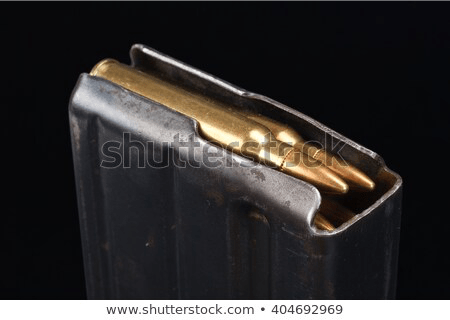
The M16s have been jamming. The spring is too strong and it pushes 2 rounds in to the chamber instead of one. I told him that I was aware of that. He said the current solution is to only load 18 rounds into a magazine instead of 20. This will take tension off of the spring. Keep your weapon clean.
Yesterday a guy in our squad, (“another FNG like you”), saw a gook dressed like a farmer walking out of the forest with a rifle. He asked another marine what to do and before he got an answer the gook shot a nearby marine dead. “If you see a gook with a rifle, waste him, don’t wait for permission.” You are the dead marine’s replacement.
Take your salt tabs. We are losing more marines to heat casualties than to combat.
(It was extremely hot and humid. Everyone was constantly soaked in sweat with subsequent decrease of blood sodium levels. Sometimes marines had to be evacuated but often they just needed a rest and to drink water with salt tabs.)
Two iodine pills in every canteen or you will get so sick you wish you were dead.
All water out in the bush came from streams, or occasionally village wells. Someone also had the bright idea of using empty gasoline cans to supply water to the field. Unfortunately the marines who clean the cans did a lousy job. Marines that were brave enough to drink it puked it all back up. If you drank stream or well water and didn’t use your iodine tabs you were likely to get dysentery, (diarrhea with blood).

Tomorrow morning our platoon is going on a “Sweep” well outside the perimeter for the whole day. We need to roust out some NVA and get some kills.
Search and destroy, body count, kill, was the strategy from the top.
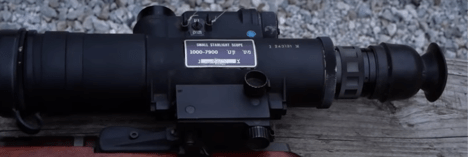
I am sure I asked him a lot of stupid questions. And finally, he told me I was going out to set up an LP tonight with 2 other cherries who had a little bit of experience. They were going to show me the ropes and teach me about the Starlight Scope which was an early night vision device.
The squad leader took me over to my fire team’s area. There were some fighting holes already occupied but no place for me to set up for the night. No worries. I would be spending the night way out ahead of the perimeter at the LP. But first, our fire team along with one other will be going on a patrol outside our perimeter. Enemy troops continually probed in small groups looking for weak areas to attack or set up concealed fighting positions for night attacks.
We were going to secure our area by maintaining an active defense.

My First Patrol in the Bush
My fire team leader briefed me on what to be prepared for, like snipers, or short intense attacks by the enemy followed by them disappearing into the jungle. Don’t make any moves that aren’t necessary; don’t touch anything that you don’t need to touch; watch where you are stepping; take it slow, drink lots of water; follow the example of your fellow marines.
We headed out immediately. We walked a long time without incident. There were several companies of marines, spread out over a wide area in the vicinity. We could hear a lot of gunfire and explosions in the distance where they were. We were not going to dash over there and help out. Our turn would come. That was someone else’s war for now. Meanwhile we walked through a dense forest into an open area and then back into another forest. We weren’t carrying any extra ammo for special weapons because it was just riflemen on this patrol. We needed to move quickly to scan a large area. It was exhausting.

When we took a break, I got to eat my first C rations, (canned rations). A marine in my fire team wanted to trade me his ham and lima beans for my beans and franks. I made the trade to get in good with my group. Boy was that a mistake. Ham and lima beans were terrible. We heated the food, (garbage), with heat tabs and ate it right out of the can. How disgusting that was. There were no junior mints to clear the taste out of my mouth. Everyone had a good laugh that I gave up my beans and franks in trade for the most despised meal in Southeast Asia. At least there were canned peaches in the meal packet.
The luncheon date didn’t make any friends for me nor did anything else on that day or the next. I learned that day that marines with time in the bush have all lost friends. They don’t want to make any new friends. It was too painful to lose them.

We had no sightings and no contact with enemy troops. We passed along the edge of a few villages and just got blank stares from the residents. I was surprised that they did not greet us with welcoming smiles. The experienced marines warned me that we were not well liked in this area.
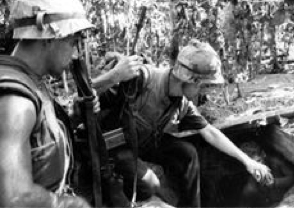
During our long hot day we came across abandoned fighting holes and bunkers that showed evidence of recent use.
By late afternoon we arrived back at our “home” for the night and prepared for darkness.
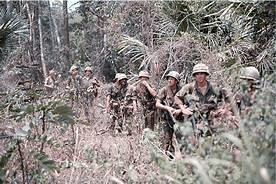
We were told that we would be resupplied in the morning before setting out on a “sweep”, or “search and destroy” mission. For now, we 3 “cherries” were taken out by our squad leader to set up a listening post, (LP).
An LP is a fighting hole or holes placed out in front of the main defensive perimeter to be a first line of awareness and defense against night attacks. The enemy was very skilled at quietly penetrating the perimeter of entrenched marines in the darkness. Each platoon had their own listening post in front of their position.
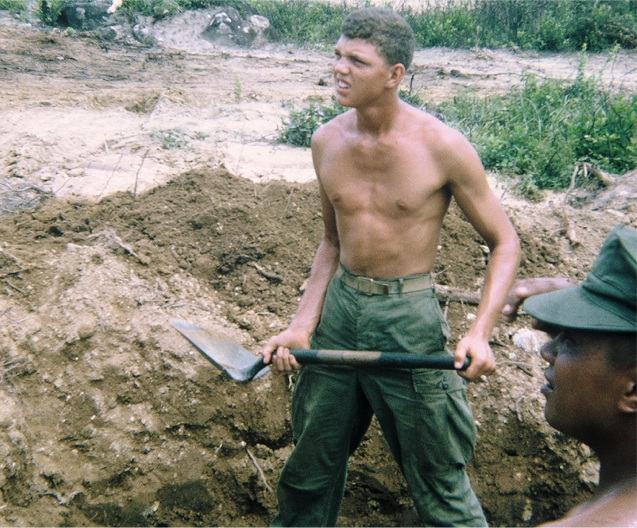
We were dropped off at a place selected by our platoon leader. He told us to dig a hole for 3 people. He said he would be back before dark with more instructions.
We were already bone tired but proceeded to use our small folding entrenchment shovels, (E-tools) to make our home for the night. As previously reported, I was miserably incompetent at this task. It caused me severe back pain after a short time of digging.
My LP comrades scolded me for being so slow. If I was clever, or a smart ass, I could have asked why they didn’t tie up some dogs out here to warn us of a sneak attack. Other grunts would pass by and stop and chat. Most were on their way to dig a crap
hole away from the perimeter, but close to us. We picked up some interesting bits of info here and there.
Some grunts carried small transistor radios to listen to news and music on the local military AM station. Robert F Kennedy was running for president and promising to end the war in Vietnam. More and more of the troops were starting to line up behind his candidacy. They talked about the insanity of this war and the need to stop the widespread killing that had no beneficial results. The new mantra was stay down, stay alive, don’t try to be a hero. (Thanks again Dad)
Our squad leader came back to our LP and gave us a tutorial on use of the Starlight Scope. Take breaks so you don’t get “crossed eyed”. Don’t mount the scope on your rifles because you might get trigger happy and shoot a water buffalo and reveal our position. Operate it by hand hold. We were warned about “hallucinations”. Our watch rotations were; First rotation, use the scope, totally awake. Second rotation, full sleep. Third rotation, on standby, sitting up with rifle in hand. Two hour shifts. “I will be making the rounds of the squad positions as well as your LP. You better not be asleep on watch. Don’t fire your weapon unless you are sure there are enemy soldiers moving on us. If you are under attack shoot off a flare. Once the shooting starts stay low in your hole
because the rounds will be coming in both directions over your heads.”
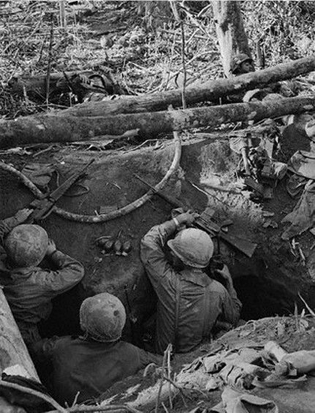
Before you know it we had finished our canned rations and it was dark, really dark.
We barely had enough room in the hole for one curled up in a ball lying down, one sitting, and one kneeling, squatting or standing. My first shift was on “standby” and I observed how the scope was being used. All three of us were ready to fall asleep.
During my turn as “standby” in the LP I spent some time taking “inventory” of today’s patrol.
I got to know a few grunts in my squad. I learned some techniques and precautions for moving in enemy territory, walking rear, walking point, how to make use of the “bug juice” to repel the ever present and hungry mosquitoes. We all had a bottle of bug juice strapped to our helmets for quick access. Prevention of malaria was a priority. It was a big problem in Vietnam. (My friend from Chicago, John Tutor, suffered from malaria for many years after the war.)

I tried to see what was in view in front of our fighting hole but couldn’t see anything on this moonless night. I probably dozed off now and then. The first shift was uneventful and now it was my turn to use the scope. When you put the eyepiece to your eye you see a green, faintly lit background which enhances the view. You can see the shapes of trees and bushes. I stared into it intensely because I didn’t want any bad guys getting too close. After a while I started hallucinating that a tree was a man carrying a rifle. I rubbed my eyes and shook my head and tried again and saw just a tree. I could barely maintain a steady position and was tense with fear. Once again I “saw” a man with a rifle moving. I decided to wake up the standby marine who was dead asleep. I needed a second opinion. He resisted waking up but eventually looked through the scope and said there were just trees out there. I was so relieved when my shift ended and no-one had slipped through our position or crawled in to our hole and gutted us. In spite of my fear I slept like a dead man until it was my turn to be on standby again. I got another shift on the scope and figured out how to refresh myself if I started to hallucinate. We made it through the night alive but not very well rested.
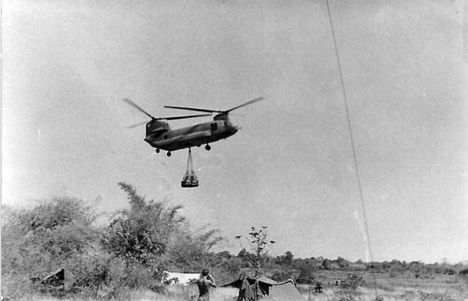
First thing in the morning. A large group of us went and unloaded the big resupply helicopter, (Chinook). Mostly ammo and food.
We were aggressively pushed to pack up for a sweep of the whole area. An all day affair. Of course they did not tell us exactly where we were going. It didn’t matter anyway.
Our platoon of maybe 35, headed out in groups in different types of formations. It depended on the terrain and the spacing between squads that was ordered by our platoon leaders. The platoon became a wide arc of men, “sweeping” the valley at the base of some hills. It was fascinating to watch. We seemed like an invincible group. We went past some villages without incident. Then we crossed some hills into a more jungle type environment.
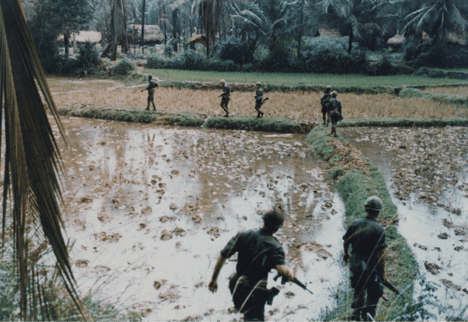

It was amazingly beautiful. Wet feet and struggling through muddy terrain took some of the tourist feel away. We kept pressing onward, down to the next valley, where it was
out in the open, super hot. We were bait. We were dangling ourselves in front of the enemy, but no shots were fired so far. We could hear fighting in the distance.
A marine in my fire team found a tunnel opening. The enemy was expert at tunneling for shelter, surprise attacks, quick ambushes.

Someone determined that this tunnel wasn’t a problem for the moment. Since I was the newest guy on the team, I was ordered to stay for a few minutes while they moved on. When they were clear I was to throw a grenade into the tunnel and run like hell and catch up to them. Being left alone was at the top of my list of fears. So my “few minutes” of waiting was maybe 30 seconds. I popped a grenade and rolled it into the tunnel and ran like hell in the direction I thought the rest of the group went. But, wrong way. We were in an area of thick vegetation but dry and forest like. I called out for my fire team leader. He called back from a nearby parallel trail. He said to stay parallel to them and stay in voice contact. After an eternity of walking alone, (4 minutes?), we were rejoined on the open “trail”. Unnerving. Were they using me, the FNG, as bait. Or was I just a fuck-up who went the wrong way? What a reassuring thought!
We went through an open valley and then started to loop around to complete the circle of our sweep. We went over some more hills and then walked along and in a stream for a while which seemed like a very vulnerable place. Needed water anyway.
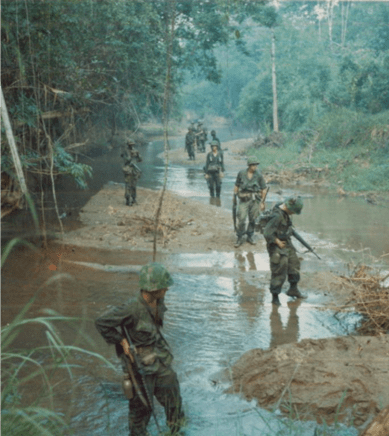
We made it back to our original area of operation unscathed. Everyone was surprised that we had no contact the whole day.
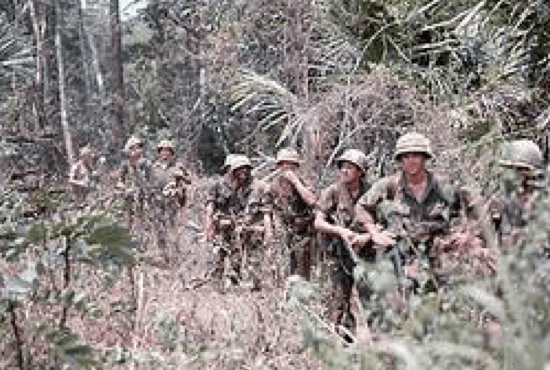
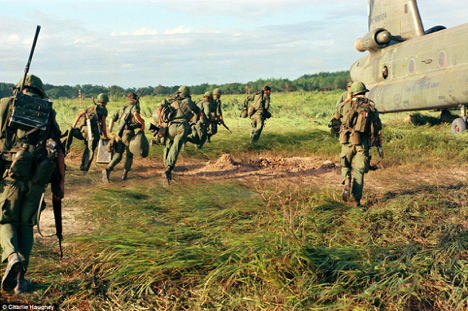
Then another surprise. We were getting pulled out of the area and going back to Phu Bai. The NVA disappeared. Probably because they were outnumbered. They’ll find some other Americans to hit and run soon enough.
We had an uneventful night, other than sleeping in a dirt hole with one third of the night on watch. We were extracted early the next morning.
What did I learn:
-We hump the bush (and man an LP) as bait for the enemy.
-Tunnels may be a good place to rest in the cool shade.
-Most marines who have been in the bush for too long turn mean and want to kill for revenge.
-The daily suffering is overwhelming; skin rashes, diarrhea, mosquitoes, wet feet with blisters, overwhelming heat with dissatisfying water, fatigue from long humps with a heavy load, constant alertness and fear.
-The water is warm and brown; the iodine tabs make it safe but you have to swallow it right away because it tastes so bad; no swishing around in your mouth; no gator aid powder; there is no pleasure or refreshment in it, just survival.
-The people of Vietnam do not, as a whole, see us as conquering heroes.
The return to Phu Bai found us in a small transient tent village after we picked up our seabags in the holding warehouse. We got showers and meals and crashed hard in our cots. In the morning we were rousted out of bed for breakfast and then sent on trucks to some part of the base perimeter to fill sand bags. This is one thing that makes everyone so angry. The lack of enough respect to give us at least a half day to rest. I had only been out for 2 days and I was toast. The main group that I joined had been out for maybe 2 weeks.
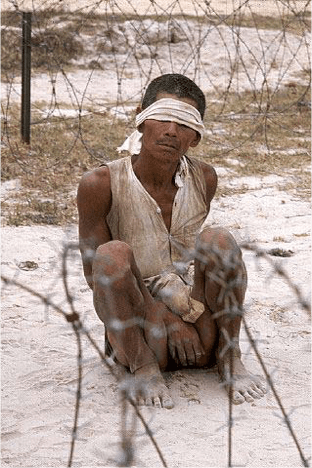
In the area where we were filling sand bags, there was a VC prisoner sitting on top of a bunker with his hands tied behind his back, blindfolded in the hot sun. I made the mistake of expressing sympathy for him to my colleagues. Everyone else seemed to think the prisoner was getting what he deserved. It looked like torture to me. I felt ashamed for not giving him water because I was afraid of the repercussions.
That day or the next I got orders to go back to Danang and officially join a combat unit. I was assigned to B Company, 1st Battalion of the 27th Marine Regiment. I flew out in a small plane with a dozen other guys after saying goodbye to no-one.

It was about the middle of May. I had tiptoed around the edges of the war for a few weeks without being connected to anything or anyone. I think the machine finally tracked me down and put me somewhere more permanent. I was very afraid of what was next.
“The communists had launched a May offensive, also known as mini-Tet. American generals were aggressively pushing a counteroffensive. May 1968 would turn out to be the bloodiest month of the bloodiest year for Americans in Vietnam.
Washington Post
Glossary
Basecamp The place where you live, on a Base, when you are not out in the field on a combat mission
Bird Helicopter
Blown Away killed or wounded and taken off the battlefield
Boot, cherry a marine who is new in country and doesn’t know shit about anything He is considered dangerous to the old timers because they make stupid mistakes, can’t keep up and get people killed
bush out in the field away from the rear bases
Broken Arrow This term is used when there are radio transmissions requesting artillery, air support, or naval gunfire when your position is overrun by the enemy. It means specifically: we are requesting that you direct your fire onto our positions
C Rations Canned food that has already been cooked
Charlie, short for Victor Charlie — Viet Cong or just any Vietnamese that is considered suspicious
chuck--white man
CH-46 or Chinook—-large double rotor helicopter which was used for insertion and extraction of troops, resupply and medevacs
Corpsman what a “medic” is called in the Marine Corps
Danger Close when your own supporting fire, like mortars or artillery, may land very near because the enemy is in your midst
“dee dee” Get the hell out of here/there quickly (adapted from Vietnamese)
dog tags a necklace worn with 2 metal id tags showing name, rank and serial number One gets pulled off the necklace if you are killed and one stays on you
don’t mean nothin’ it’s all hopeless like saying, “whatever”
Flak Jacket body armor
FNG Fucking new guy (see ‘cherry’ above)
Fragging Trying to commit murder by throwing a fragmentation grenade in to an officer’s or sergeant’s living quarters or fighting hole. A way to get revenge for mistakes, harassment or excessive enthusiasm for combat
Free fire zone Anyone that looks healthy is a target – the area is full of enemy troops and supportive civilians who are considered combatants
Friendly fire when troops are fired upon by nearby troops, artillery, or air strikes due to confusion
get some go out and find and kill the enemy
grunt a marine who is walking in the bush, ready for combat, carrying his gear, weapons and ammunition
Huey Bell UH 1 helicopter; used for troop transport, fire support and scouting
hump walking and carrying your gear, weapons, and ammunition out in the field away from a combat base. The average load was about 70 pounds.
In country — in Vietnam– one is always asked, “how long have you been in country” and that establishes your status
KIA–killed in action (also, “wasted”)
Lifer—– someone who is career military. Often a derogatory term meaning that the lifer puts career, military rules and decorum above the welfare of the troops
LZ helicopter landing zone
LP Listening Post A fighting hole placed forward of the night perimeter to monitor enemy movement and prevent surprise attacks. Often assigned to “cherries”. It was dangerous because you were sacrificial bait to absorb the enemy’s first strike.
medevac— medical evacuation usually by helicopter
MIA Missing in action
NCO Non Commissioned Officer a corporal or sergeant who can lead various groups of marines. They are not commissioned officers, but designated leaders.
NVA--soldier or soldiers in the North Vietnamese Army–NVA troops have official uniforms; Charlie has some rudimentary uniforms but usually blends in with the civilian population
overrun— When the enemy has infiltrated or crossed your perimeterinforce
the world — back home in the USA– “I’m going back to the world in 43 days”
salt tabs–– salt, (NACL) as a pill you sweat so much the salt leaches out your body and you could suffer intestinal problems, cognitive impairment, and muscular difficulties
splib–black man
“there it is” no matter how ridiculous, it’s true; I told you so; the marine corps does what it does and Charlie does what he does
WIA wounded in action
A portion of this glossary is derived from the excellent book, “Matterhorn”, by Karl Marlantes. Marlantes was a highly decorated Marine Corps combat veteran in Vietnam.
His book is considered one of the best of the Vietnam novels.
 thomasleecurran.com